Posts mit dem Label Müll werden angezeigt. Alle Posts anzeigen

Freitag, 12. Juni 2009

Neues Denken aus Brasilien (1): Müll als mentaler Ausdruck und zivilisatorisches Problem

Film-Nr.: 361
Vorführungstermin: Freitag, 14. August 2009, 20.30 Uhr [VN36]
Themenschwerpunkt: Neues Denken aus Brasilien (1) | Archäologie - Anthropologie - Ethnologie (4) | Müll (1)

Englischer Titel: Mountain Maker
Originaltitel: Fazedor de Montanhas
Deutscher Titel: Berg-Erzeuger
Herkunft: Brasilien 2008
Laufzeit: 52 min.
Sprachfassung: Portugiesische Orignalfassung mit englisch-deutschen Untertiteln

Regie: Juan Figueroa
Produzent: Alcione Alves, Marcelo Sollero
Schnitt: Pedro Duarte, Marcelo Tupi (sound)
Kamera: Carlos Nascimento
Produktion: Imagem Essencial, São Paulo

URL Film-Homepage: http://www.fazedordemontanhas.com.br/english/index.html
Premierenstatus: Deutsche Erstaufführung
Bisherige Aufführungen: CINESTRAT Film Festival, Spanien, Bahia Int. Film Festival, Brasilien; Sâo Paulo Int. Film Festival, Brasilien;


Kurzinhalt: Müll als mentaler Ausdruck und zivilisatorisches Problem.

Trailervideo: http://globians.blip.tv/file/2252813 + http://www.youtube.com/watch?v=j81LEs8z8hE

Englische Synopsis: Phenomena that are apparently simple conceal extremely complex behaviors. Waste is perhaps that which we do not wish to see.
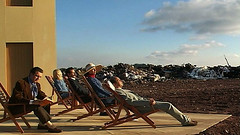
Mountain Maker (Brazil 2008)

Director's Statement: MOUNTAIN MAKER BY ITS DIRECTOR I wanted to make a naked movie, a bare-bones movie. The one left after the decomposition of the flesh of film, which is action, movement. I wanted a nearly static movie, stuck like a stake, as a sign, a landmark, so that movement would be added by the spectator with his own images. The spectator is the one who has to give the film a body. His own body. I conceived Mountain Maker at a time I was fascinated by the theory of chaos. I had just found out this way of seeing the world that at last brought science, thought, and poetry together, and I thought it would be an excellent way to try to understand such an apparently simple phenomenom as waste. Alcione Alves, my producer, and I made a serious effort to find people who dealt with each of the levels into which we wanted to inquire: material waste; the human being treated as waste by a depredating society; the mental waste each individual carries; and the conceptual waste imposed on us without our awareness. By covering this chaotic universe we hoped to reach an order, a principle that would integrate all those dimensions. The result surprised us. In each step a law was obeyed: waste is everything we do not want to see. It is thus of little use to keep on discussing about the ozone layer or atomic recycling if previously we do not solve the problem of our own inner waste, origin of all the others, like a stone thrown into the water, that produces concentric waves. Indifference first makes things into waste, soon dehumanizes us to the point where we get mixed with it. Sleepless characters throughout the movie remind us of this law. More than a documentary, Mountain Maker is an essay-film. Participants were not interviewed in a strict sense. They were not pieces of a puzzle. We treated them as actors, with detailed screenplays based on each one’s ideas, and precise framings. They were all shot in a black box, assimilated to one another, without references to their names or jobs. We intended to create a continuum of words from which inner dialogues, and image associations could arise, spiral rather than straight ideas. Mountain Maker is an expedition inwards, an anabasis in Greek sense. Waste could be its pretext. Waste as a phenomenon of human spirit, rather than a consequence of human action. JUAN FIGUEROA
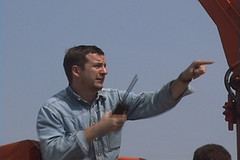
Mountain Maker (Brazil 2008) Director Juan Figueroa

Englische Kurzbio JUAN FIGUEROA, Regisseur: Born in Toledo, Spain, in 1965. He is graduated in Philosophy from the University of Salamanca, Spain. He studied filmmaking in Madrid, São Paulo, and San Antonio de los Baños, Cuba. His short films are Lixografías (2001), Sunday 23rd Octuber (2005), screened at the 17º Gerona International Film Festival, Molino Individuo (2006), Auto de Fe (2007), and Jardin Cerrado (2008). Mountain Maker is a medium-length essay-film and won the Jury’s Special Prize at Cinestrat 2008, Spain. He has written a book of poems, Séptimo Seísmo (ed. Librosprohibidos, Salamanca, Spain, 2008) and translated Paulo Bomfim.

GLOBIANS DOC FEST BERLIN
August 12 - 17, 2009
Kino Toni, Antonplatz

Afrikanische Lebenswelten (3) | Ägypten (1) | Müll (2):
Das soziale Ökosystem der Müllverwertung in Kairo als Sphäre der Frauen

Film-Nr.: 441
Vorführungstermin: Samstag, 15. August 2009, 17.30 Uhr (Vorfilm) [VN44]
Themenschwerpunkt: Afrikanische Lebenswelten (3) | Ägypten (1) | Müll (2)

Englischer Titel: Mona
Originaltitel: Mona
Deutscher Titel: Mona
Herkunft: Deutschland 2008
Laufzeit: 30 min.
Sprachfassung: Arabische Originalfassung mit englischen Untertiteln

Regie: Agnes Rossa
Produzent: Ute Dilger
Schnitt: Huynh-Trang Lam, Ralf Schipke (sound)
Kamera: Diana Harders
Akademische Betreuung: Ute Dilger
Produktion: Kunsthochschule für Medien Köln

URL Film-Homepage:
Premierenstatus: Berliner Erstaufführung
Bisherige Aufführungen: Donostia – San Sebastián, 7th Human Rights Film Festival, Donostia, San Sebastián, Spanien; documentary-filmweek, Hamburg; Rom International Film Festival, Italien; Cineposible International Film Festival, Human Rights, Almendralejo, Spanien; Viennale International Film Festival, Wien, Österreich;


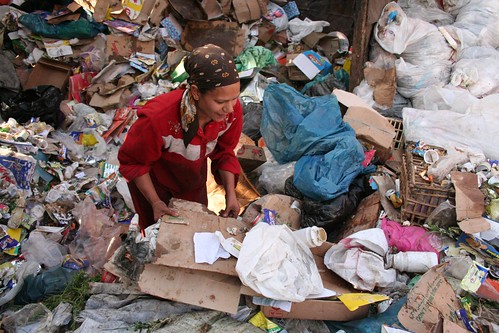
Mona (Germany 2008)

Kurzinhalt: Mona lebt mit ihren vier Töchtern in einem 5-Quadratmeter-Apartment in Kairo. Um ihre Familie nach dem dem Tod ihres Ehemanns zu ernähren, sortiert sie täglich den Müll der Stadt. Die Kinder von Mona besuchen die Schule. Mona träumt davon, dass ihre Kinder nach einem erfolgreichen Schulabschluss ein besseres Leben als sie selbst haben werden. Ihr ganzer Alltag zentriert sich um ihre Töchter, die sie mit viel Liebe, Stolz und Würde erzieht.

Trailervideo:

Englische Synopsis: Mona lives with her four daughters in a five square metre appartment in Cairo. To support her family after the death of her husband, Mona sorts the city's garbage every day. Mona’s daughters attend school. Mona dreams of seeing her children graduate from school and lead a better life than herself one day. Her whole life revolves around her daughters whom she brings up with much love and pride.

Mona (Germany 2008)

Englische Werkbeschreibung: The film does not only provide insight into the family’s living conditions, hopes, dreams, problematic and joyful experiences but also informs about the waste system and its supporting infrastructure in one of the largest metropolises of the world.

GLOBIANS DOC FEST BERLIN
August 12 - 17, 2009
Kino Toni, Antonplatz
Afrikanische Lebenswelten (4) | Ägypten (2) | Müll (3):
Das soziale Ökosystem der Müllverwertung von Kairo vor seiner Industrialisierung

Film-Nr.: 442
Vorführungstermin: Samstag, 15. August 2009, 17.30 Uhr (Hauptfilm) [VN44]
Themenschwerpunkt: Afrikanische Lebenswelten (4) | Ägypten (2) | Müll (3)

Englischer Titel: Garbage Dreams
Originaltitel: Garbage Dreams
Deutscher Titel: Müllträume
Herkunft: USA 2009
Laufzeit: 72 min.
Sprachfassung: Arabische Originalfassung mit englischen Untertiteln

Regie: Mai Iskander
Produzent: Mai Iskander
Schnitt: Jessica Reynolds, Kate Hirson
Kamera: Mai Iskander
Musik:
Produktion:

URL Film-Homepage: http://www.garbagedreams.com
Premierenstatus: Europäische Erstaufführung
Bisherige Aufführungen: Rhode Island International Film Festival, Rhode Island, USA; Connecticut Film Festival (Connecticut) USA; Seattle International Film Festival, Seattle (Washington) USA; Maryland Film Festival (Maryland) USA; Newport Beach Film Festival, Los Angelos (Kalifornien) USA; Nashville Film Festival (Tennesee) USA; Tallahasee Film Festival (Florida) USA; Vail Film Festival (Colorado) USA; Phoenix Film Festival (Arizona) USA;


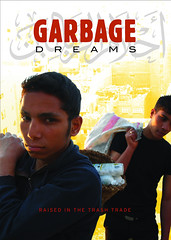
Garbage Dreams (USA 2009) poster

Kurzinhalt: Das Leben von drei Teenager-Jungen, die in den Müllhandel der "Zaballeen" im Mokattam-Stadtviertel von Kairo hineingeboren wurden. Lange vor vermeintlich modernen "grünen" Konzepten, haben die rund 60.000.Zaballen ihr Überleben aus der Wiederverwendung von 80 Prozent des gesammelten Mülls gesichert. Als die Stadt Kairo sich nun dem internationalen und globalisierten Müllhandel verschreibt, stehen die Teenager plötzlich vor existenziellen Lebensentscheidungen, die sie selbst und ihre Gemeinschaft betreffen. Der Film von Mai Iskander wurde vom Sundance Dokumentarfilm Institut gefördert.

Trailervideo:

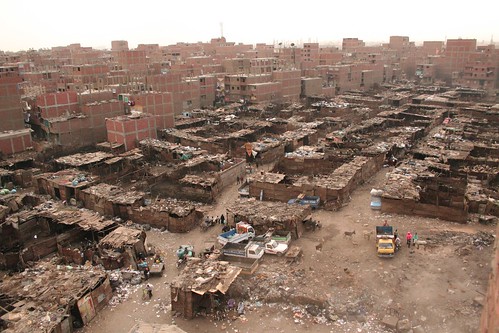
Englische Synopsis: Garbage Dreams follows three teenage boys born into the trash trade and growing up in the world's largest garbage village, on the outskirts of Cairo. It is the home to 60,000 Zaballeen, Arabic for 'garbage people.' Far ahead of any modern 'Green' initiatives, the Zaballeen survive by recycling 80 percent of the garbage they collect. When their community is suddenly faced with the globalization of its trade, each of the teenage boys is forced to make choices that will impact his future and the survival of his community.

Garbage Dreams (USA 2009) still

Englische Werkbeschreibung: 'GARBAGE DREAMS is a moving story of young men searching for a ways to eke out a living for their families and facing tough choices as they try to do the right thing for the planet. Mai Iskander guides us into a 'garbage village,' a place so different from our own, and yet the choices they face there are so hauntingly familiar. Ultimately, GARBAGE DREAMS makes a compelling case that modernization does not always equal progress.' - AL GORE Filmed over four years, GARBAGE DREAMS follows three teenage boys – Adham, a bright precocious 17 year old; Osama, a charming impish 16 year old; Nabil, a shy artistic 18 year old – born into the trash trade and growing up in the world’s largest garbage village, a ghetto located on the outskirts of Cairo. It is a world folded onto itself, an impenetrable labyrinth of narrow roadways camouflaged by trash; it is the home to 60,000 Zaballeen (also spelt Zabbaleen), arabic for “garbage people.” For generations, the residents of Cairo have depended on the Zaballeen to collect their trash, paying them only a minimal amount for their garbage collection services. The Zaballeen survive by recycling the city’s waste. These entrepreneurial garbage workers recycle 80% of all the garbage they collect, creating what is arguably the world's most efficient waste disposal system. When the city they keep clean suddenly decides to replace the Zaballeen with multinational garbage disposal companies, the Zaballeen community finds itself at a crossroads. Face to face with the globalization of their trade, each of the teenage boys is forced to make choices that will impact his future and the survival of his community.

Garbage Dreams (USA 2009) Director Mai Iskander

GLOBIANS DOC FEST BERLIN
August 12 - 17, 2009
Kino Toni, Antonplatz