Posts mit dem Label Archäologie - Anthropologie - Ethnologie werden angezeigt. Alle Posts anzeigen

Samstag, 13. Juni 2009

Heilung als kultureller und sozialer Prozess (1): "La Curación" als Tiefenschicht-Erfahrung in der dampfenden, vulkanischen Landschaft von Ecuador

Film-Nr.: 121
Vorführungstermin: Mittwoch, 12. August 2009, 20 Uhr — [VN 12]
Themenschwerpunkt: Heilung als kultureller und sozialer Prozess (1) | Archäologie - Anthropologie - Ethnologie (1)

Englischer Titel: The Healing
Originaltitel: La Curación
Deutscher Titel: Die Heilung
Herkunft: Ecuador/USA 2008
Laufzeit: 55 min.
Sprachfassung: Spanische Originalfassung (tw. Quichua), englische Untertitel

Regie: Meredith Zielke, Yoni Goldstein
Mitarbeitende Regie: Andrea Moreno-Beals, Anica Madeo, Alex Belhaj, Dana Kuhn, Gonzalo Escobar, Kyle Fish, Micah Middaugh, Meredith Zielke, Sergio Huarcaya, Susan Fawcett
Produzent: Meredith Zielke, Patrick Schaller, Sergio Huarcaya, Yoni Goldstein
Schnitt: Andy Sabin
Musik: Andrea Moreno-Beals, Micah Middaugh, Susan Fawcett
Produktion: School of the Art Institute of Chicago

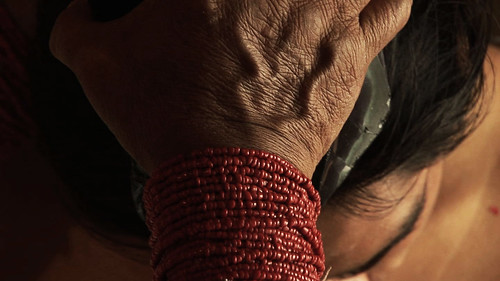
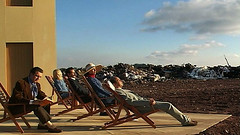
La Curación (Ecuador/USA 2008) still

Premierenstatus: Europäische Erstaufführung
Bisherige Aufführungen: Ann Arbor Film Festival, Ann Arbor, USA;


Kurzinhalt: Filmischer Versuch zur Ethnographie in der dampfenden und vulkanischen Landschaft von Ecuador, bei dem Erzählungen eines epileptischen Revolutionärs, eines feuerschluckendern Schamanen, eines Arztes und eines „Campesino“-Visionärs ein Teifenverständnis von Heilung, Transparenz und Körpermythologie ermöglichen.

Englische Synopsis: 'La Curación' is an experiment in ethnography located in the breathing, volcanic geography of Ecuador. Told through a prism of narratives (an epileptic revolutionary, a fire-breathing shaman, a poet-physician, a 'campesino' visionary), the film reveals deeply layered understandings of healing, permeability, and body mythology.

Dieser Film aus dem Programm des Globians Doc Fest wird wiederholt und zwar am 02. Dezember 2009 um 22.15 Uhr im Berliner Kino "Eva Lichtspiele", Blissestraße 18, Berlin-Wilmersdorf, U-Bahnhof Blissestraße.

GLOBIANS DOC FEST BERLIN
August 12 - 17, 2009
Kino Toni, Antonplatz

Freitag, 12. Juni 2009

Die Frische der kanadischen Provinz (3):
Sutikalh — der Wintergeist

Film-Nr.: 331
Vorführungstermin: Freitag, 14. August 2009. 16.30 Uhr [VN33]
Themenschwerpunkt: Die Frische der kanadischen Provinz (3) British Columbia | Vom Überleben lokaler Kulturen (1) Kanada | Die Zerstörungswut der Freizeitindustrie (1) | Archäologie - Anthropologie - Ethnologie (2)

Englischer Titel: Quiet Struggle — Sutikalh the winter spirit
Originaltitel: Quiet Struggle — Sutikalh the winter spirit
Deutscher Titel: Stiller Kampf: Sutikalh — der Wintergeist
Herkunft: Japan/Kanada 2009
Laufzeit: 69 min.
Sprachfassung: Englische Sprachfassung

Regie: Kazutaka Tokoda
Produzent: Kazutaka Tokoda
Schnitt: Kazutaka Tokoda, ,
Kamera: Kazutaka Tokoda
Musik: traditionals
Produktion: Japonesia Video, Tomakomai, Hokkaido, Japan

Premierenstatus: Weltpremiere


Kurzinhalt: Der Kulturkampf zwischen dem Lilwat Stamm in British Columbia und den "Entwicklern" einer Ski-Lodge für die Winterolympiade 2010 in Vancouver mit geplanten Abfahrtspisten, die Sutikalh, den Wintergeist in den Bergen, schädigen.

Trailervideo: http://blip.tv/file/2280605 + http://www.youtube.com/watch?v=KPTY8nUHTFE&feature=channel_page

Englische Synopsis: Land conflict and culture clash between Lilwat Natives in British Columbia and the "developers" of a ski resort in the Rocky Mountains intended for the 2010 Vancouver Winter Olympics.

Englische Werkbeschreibung: Lilwat Nation is one of Native Canadian's territories in British Columbia, in the Rocky Mountains' region of Canada. One tribe member of Lilwat is living in the mountain for eight years now. His name is Huby, the main character of this Japanese documentary. The Lilwats call the place 'Sutikalh': the winter spirit. Huby lives in a little house in order to protect at the mountain against the project of ski resort development called Whistler Ski Resort. Huby says: "We need fresh air, fresh water. We don't need a ski resort". In 2010, the winter Olympic games will be held in Vancouver. Whistler Ski Resort shall be part of the Olympic Games but has been part of Lilwat territory and culture for so long. Since the developers' announcement in 2000 Lilwat people have been protecting the 'Sutikalh' until now...

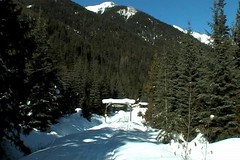
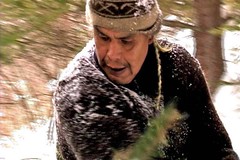
Quiet Struggle  – Sutikalh the Winter Spirit (Japan 2009)>Quiet Struggle  – Sutikalh the Winter Spirit (Japan 2009)>Quiet Struggle  – Sutikalh the Winter Spirit (Japan 2009)

Der japanische Dokumentarfilmer Kazutaka Tokoda hat bereits zwei seiner früheren Werke beim Globians Doc Fest vorgestellt: 2005 seine abendfüllenden Dokfilm "WAIA" über die Initiationsriten der vom Amazonas nach Matto Grasso zwangsumgesiedelten Xavante in Brasilien und 2007 "Memory of the Waves" über den japanischen Holzkünstler Arashiro Yasuhiro, der noch Kanus aus einem Einbaum schnitzt. Kazutaka Tokoda hat seinen Besuch beim 5. Globians Doc Fest Berlin bereits bestätigt; er wird der erste Filmemacher sein, der in der fünfjährigen Projektgeschichte des Globians Doc Fest insgesamt drei Mal die weite Reise von Japan nach Deutschland antritt und mit insgesamt nunmehr drei Filmen im Festivalprogramm vertreten war. Wir freuen uns sehr. Herzlich Willkommen Tokosama!

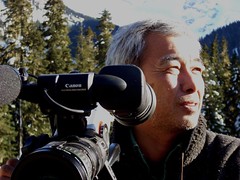
Quiet Struggle  – Sutikalh the Winter Spirit (Japan 2009) Director Kazutaka Tokoda

GLOBIANS DOC FEST BERLIN
August 12 - 17, 2009
Kino Toni, Antonplatz

Die Wiederentdeckung einer versunkenen Zivilisation im Hochland von Peru und ihr Konflikt mit den heutigen, lebenden Nachfahren

Film-Nr.: 341
Vorführungstermin: Freitag, 14. August 2009, 18.00 Uhr [VN34]
Themenschwerpunkt: Vom Überleben lokaler Kulturen (2) Peru | Archäologie - Anthropologie - Ethnologie (3)

Englischer Titel: Rapayan
Originaltitel: Rapayan
Deutscher Titel: Rapayan
Herkunft: Kanada 2008
Laufzeit: 52 min.
Sprachfassung: Spanisch-Französische Originalfassung (tw. Quichua), englische Untertitel

Regie: Francis Delfour
Produzent: Sylvie Gagné, Daniel Plante
Schnitt: Nicolas Belpaire
Kamera: Sandra Rodriguez
Musik: Bruno Marcil
Produktion: Arrimage Productions, L'Assomption, Quebec


Premierenstatus: Europäische Erstaufführung
Bisherige Aufführungen: TAC Film Festival, Eugene (Oregon), USA

Kurzinhalt: Ein kanadischer Anthropologe aus Quebec auf den Spuren einer früheren und noch unbekannten Zivilisation im Hochland von Peru, die im Konflikt steht mit ihren heutigen und direkten Nachfahren.

Englische Synopsis: Shot in Peru's highlands, the film follows a Canadian archaeologist from Quebec who has discovered an unknown civilization and the conflict that arises with its direct descendants.

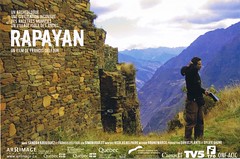
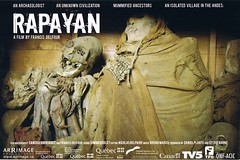
Rapayan (CANADA 2008) postcardRapayan (CANADA 2008) postcardRapayan (CANADA 2008) Director Francis Delfour

Englische Werkbeschreibung: This film is an adventure that whirls together culture shock with elements of the mystical. It focuses on the upheaval that the people of the isolated village of Rapayan are experiencing. Living in Peru’s highlands, they are the direct descendants of a once great civilization. As we follow canadian archaeologist Alexis Mantha and his team searching their ancestors’s ruins, we discover a culture that has forgotten its past. Conflict arrises. The ruins threaten to crumble and Rapayan’s peace is now in jeopardy. The village is going through a turning point. The signs are there. A foreigner is unearthing mummies. A road is being built, linking the village to the rest of the world, openning the path to a different future. Past, present and future are becoming blurred as a paved road advances towards Rapayan and modernity is catching up with it's people. — In Rapayan, the dismembered and mummified remains of the ancestors are lined up on a long wooden counter inside the village school, where they seem to watch over the children. In Rapayan, the villagers have lived in isolation for generations, in a region marked by magnificent highlands, surrounded by spectacular cliffs, terraced crops and numerous streams. In Rapayan, invasions have been numerous; the Incas and Spanish destroyed the old ones’ way of life, but the ancestors’ cult persists. Yet something even more fearful than all of the past’s invaders is slowly advancing toward the village: the highway. In Rapayan, there is also Alexis Mantha, a young Canadian archaeologist who has stumbled on a treasure: 55 ruin sites, including fortresses, murals, multi-story buildings, mausoleums, galleries, warehouses… in short, an entire civilization. This film is an adventure that whirls together culture shock with elements of the mystical. It focuses on the upheaval that the people of Rapayan are experiencing. Perched 4,000 metres high in Peru’s highlands, they have been living according to their traditions for centuries.

Francis Delfour is a director and screenwriter based in Montreal, Canada. In the last eight years he wrote several scripts for both documentary and fictional films which have been broadcasted in Canada, USA, Europe, Asia and South America. Mr. Sabbagh, his first documentary as a director, have been programmed in various festivals. He also was director of photography for The Ennemy Within and is a restaurant critique for the Nightlife Magazine. In a previous life Francis Delfour have completed a master’s degree in anthropology.

Dieser Film aus dem Programm des Globians Doc Fest wird wiederholt und zwar am 14. Oktober 2009 um 18.30 Uhr im Eiffelturm-Kino Berlin (im Centre Français de Berlin), Müllerstr. 74, U-Bahnhof Rehberge/Afrikanische Straße.

GLOBIANS DOC FEST BERLIN
August 12 - 17, 2009
Kino Toni, Antonplatz

Neues Denken aus Brasilien (1): Müll als mentaler Ausdruck und zivilisatorisches Problem

Film-Nr.: 361
Vorführungstermin: Freitag, 14. August 2009, 20.30 Uhr [VN36]
Themenschwerpunkt: Neues Denken aus Brasilien (1) | Archäologie - Anthropologie - Ethnologie (4) | Müll (1)

Englischer Titel: Mountain Maker
Originaltitel: Fazedor de Montanhas
Deutscher Titel: Berg-Erzeuger
Herkunft: Brasilien 2008
Laufzeit: 52 min.
Sprachfassung: Portugiesische Orignalfassung mit englisch-deutschen Untertiteln

Regie: Juan Figueroa
Produzent: Alcione Alves, Marcelo Sollero
Schnitt: Pedro Duarte, Marcelo Tupi (sound)
Kamera: Carlos Nascimento
Produktion: Imagem Essencial, São Paulo

URL Film-Homepage: http://www.fazedordemontanhas.com.br/english/index.html
Premierenstatus: Deutsche Erstaufführung
Bisherige Aufführungen: CINESTRAT Film Festival, Spanien, Bahia Int. Film Festival, Brasilien; Sâo Paulo Int. Film Festival, Brasilien;


Kurzinhalt: Müll als mentaler Ausdruck und zivilisatorisches Problem.

Trailervideo: http://globians.blip.tv/file/2252813 + http://www.youtube.com/watch?v=j81LEs8z8hE

Englische Synopsis: Phenomena that are apparently simple conceal extremely complex behaviors. Waste is perhaps that which we do not wish to see.

Mountain Maker (Brazil 2008)

Director's Statement: MOUNTAIN MAKER BY ITS DIRECTOR I wanted to make a naked movie, a bare-bones movie. The one left after the decomposition of the flesh of film, which is action, movement. I wanted a nearly static movie, stuck like a stake, as a sign, a landmark, so that movement would be added by the spectator with his own images. The spectator is the one who has to give the film a body. His own body. I conceived Mountain Maker at a time I was fascinated by the theory of chaos. I had just found out this way of seeing the world that at last brought science, thought, and poetry together, and I thought it would be an excellent way to try to understand such an apparently simple phenomenom as waste. Alcione Alves, my producer, and I made a serious effort to find people who dealt with each of the levels into which we wanted to inquire: material waste; the human being treated as waste by a depredating society; the mental waste each individual carries; and the conceptual waste imposed on us without our awareness. By covering this chaotic universe we hoped to reach an order, a principle that would integrate all those dimensions. The result surprised us. In each step a law was obeyed: waste is everything we do not want to see. It is thus of little use to keep on discussing about the ozone layer or atomic recycling if previously we do not solve the problem of our own inner waste, origin of all the others, like a stone thrown into the water, that produces concentric waves. Indifference first makes things into waste, soon dehumanizes us to the point where we get mixed with it. Sleepless characters throughout the movie remind us of this law. More than a documentary, Mountain Maker is an essay-film. Participants were not interviewed in a strict sense. They were not pieces of a puzzle. We treated them as actors, with detailed screenplays based on each one’s ideas, and precise framings. They were all shot in a black box, assimilated to one another, without references to their names or jobs. We intended to create a continuum of words from which inner dialogues, and image associations could arise, spiral rather than straight ideas. Mountain Maker is an expedition inwards, an anabasis in Greek sense. Waste could be its pretext. Waste as a phenomenon of human spirit, rather than a consequence of human action. JUAN FIGUEROA

Mountain Maker (Brazil 2008) Director Juan Figueroa

Englische Kurzbio JUAN FIGUEROA, Regisseur: Born in Toledo, Spain, in 1965. He is graduated in Philosophy from the University of Salamanca, Spain. He studied filmmaking in Madrid, São Paulo, and San Antonio de los Baños, Cuba. His short films are Lixografías (2001), Sunday 23rd Octuber (2005), screened at the 17º Gerona International Film Festival, Molino Individuo (2006), Auto de Fe (2007), and Jardin Cerrado (2008). Mountain Maker is a medium-length essay-film and won the Jury’s Special Prize at Cinestrat 2008, Spain. He has written a book of poems, Séptimo Seísmo (ed. Librosprohibidos, Salamanca, Spain, 2008) and translated Paulo Bomfim.

GLOBIANS DOC FEST BERLIN
August 12 - 17, 2009
Kino Toni, Antonplatz

Neues Denken aus Brasilien (4) | Vom Überleben lokaler Kulturen (3): Langzeit-Dokumentation über die Xingu vom Amazonas

Film-Nr.: 381
Vorführungstermin: Freitag, 14. August 2009, 22.45 Uhr [VN38]
Themenschwerpunkt: Neues Denken aus Brasilien (4) | Archäologie - Anthropologie - Ethnologie (5) | Vom Überleben lokaler Kulturen (3) Brasilien

Englischer Titel: Xingu, The Endangered Land
Originaltitel: Xingu, A Terra Ameacada
Deutscher Titel: Xingu — das bedrohte Land
Herkunft: Brasilien 2008
Laufzeit: 105 Min.
Sprachfassung: Portugiesische Originalfassung (tw. Sprachen der brasilianischen Ureinwohner), englische Untertitel

Regie: Washington Novaes
Produzent: João Novaes, Roberto D'Ávila, Claudio Pereira
Schnitt: Joao Paulo Carvalho, Eduardo Pop, Aline Nobrega, Eduardo Pop (sound)
Kamera: Lula Araujo, Piva Barreto
Sprecher: Washington Novaes
Produktion: Sertao Filmes, Goiania, Goias (Brasilien)

URL Film-Homepage:
Premierenstatus: Welt-Festivalpremiere


Kurzinhalt: Die magische Kultur der Xingu-Ureinwohner im Amazonasgebiet mit enormen kulturellem und natürlichem Reichtum, betrachtet als Entwicklungsverlauf über die Zeitspanne von 22 Jahren.

Trailervideo:

Englische Synopsis: Two documentaries, 22 years apart. Over a two decade span, the cultural and natural wealth of the Xingu Indigenous Peoples Territory, a magic but endangered land in the heart of Brazil.
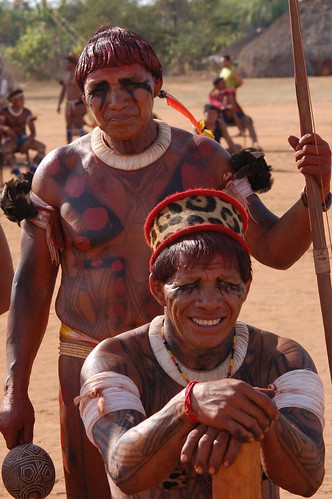
Xingu — The Endagered Land (BRAZIL 2008) still

Englische Werkbeschreibung: Let yourself experience the mysterious universe of the Xingu Indigenous Peoples, in Brazil, guided by an inspired and dense narration, a poetic photography and a seducing edition. Back in 1984, a film crew directed by documentarist Washington Novaes visited the Xingu Indigenous Peoples Territory, in the Brazilian Amazon, revealing, through the series of documentaries “Xingu, The Magic Land”, the beauty of five indigenous nations: the Waurá, Kuikuro, Yawalapiti, Metuktire and Panará. Twenty-two years afterwards, the same crew went back to Xingu to show the transformations undergone by these cultures and the threats now facing them. The original series was broadcast in 1985 and was than acclaimed as one of the best documentaries ever shown on Brazilian TV, receiving awards abroad in Cuba and South Korea and being honored with a special room at the renowned Venice Biennale. For this new series, now reedited as a one hour and forty minutes feature presentation, beyond his original crew, Novaes employed two young indigenous film makers, Maricá Kuikuro and Kiampopri Panará, who today bridge the gap between their traditional cultures and our technologies. But what has happened to the peoples of Xingu in two decades of a closer relationship with the white world? The territory is today a forest island surrounded by pastures, roads, power dams and wide deforested areas for soybean crops. The inhabitants of the territory withstand the impacts of environmental degradation around it and the closeness of the surrounding society. The villages have been overtaken by satellite dishes, solar energy cells, oil engines and electronic paraphernalia. The shamans are now very few, for the youth isn’t willing to face this tough apprenticeship path, long and full of sacrifices. They want to watch TV, to wear clothes, sneakers, sunglasses, to dance white rhythms and – a supreme ambition – to ride a potent motorcycle through the village. “The Indian world is very different from ours”, remembers Novaes. It is ruled by the spirits of water, fire, earth and the animals. Everything there is rooted in a sacred dimension”. He reminds us that, in this territory, the white technology and scientific resources add to the risk of a definite loss of identity with the intense exposition of the youth to our culture. “The old leaders say the youth carries a huge illusion regarding the white world. They think everything here to be pretty and easy. They have no idea how hard it is to survive in this world. It is a very tough moment, with a very strong internal tension. It is hard to foresee the outcomings though”. Fortunately nevertheless, as Washington puts it, “it is still a moment of coexistence between the two cultures, the native one and the white one”. Thanks to that, whoever watches “Xingu, the Endangered Land” will still be able to feel mesmerized by the touching images of cultural expressions kept alive by the indigenous nations once again filmed. The rituals, feasts, the initiation of teenagers on adult life through the ancient ritual of “thrashing wasps” among the Panarás and a beautiful reenacting by the Metuktire of their first encounter with the white man. “Meeting the Indian is a dive in another time, a wide open space of sky and earth, water and fire. A rich and colorful space, peopled by animals, vegetables, minerals and spirits”, admonishes Novaes.
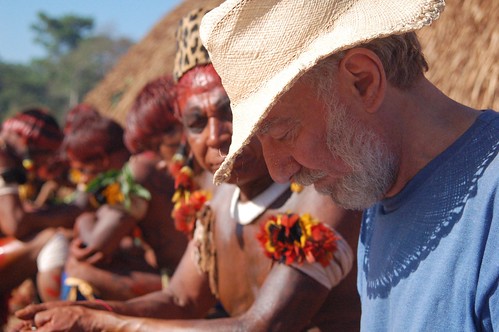
Xingu — The Endagered Land (BRAZIL 2008) Director Washington Novaes

GLOBIANS DOC FEST BERLIN
August 12 - 17, 2009
Kino Toni, Antonplatz

Australischer Kulturraum (3) Papua Neuguinea |
Deutsche im Ausland (2):
Der Papa der Chimbu aus dem Saarland

Film-Nr.: 613
Vorführungstermin: Montag, 17. August 2009, 13 Uhr (Dritter Film) [VN61]
Themenschwerpunkt: Australischer Kulturraum (3) Papua Neuguinea | Deutsche im Ausland (2) | Archäologie - Anthropologie - Ethnologie (6) | Vom Überleben lokaler Kulturen (5)

Englischer Titel: Papa Bilong Chimbu
Originaltitel: Papa Bilong Chimbu
Deutscher Titel: Papa der Chimbu
Herkunft: Australien 2007
Laufzeit: 54 min.
Sprachfassung: Englische Sprachfassung

Regie: Verena Thomas
Produzent: Verena Thomas
Drehbuch: Martyn Ives, Penny Jope, Verena Thomas
Schnitt: Verena Thomas
Kamera: Bao Waiko
Produktion: Andrew Pike (Distributor)
im Vertrieb der Ronin Film Australien

Premierenstatus: Deutsche Festival-Premiere
Bisherige Aufführungen: Tartu Festival of Visual Culture, Tartu, Estland; Pacific International Documentary Film Festival of Tahiti, Papeete, Französisch Polynesien; RAI Ethnographic Filmfestival, Manchester, UK; Belgrad Ethnographic Filmfestival; Vancouver Ethnographic Filmfestival, Kanada; Days of Ethnographic Film, Slovenien;


Kurzinhalt: Aus einem saarländischen Dorf stammend kommt im Jahre 1937 Pater Johanes Nilles (1905 - 1993) auf Papua Neuguinea an und versucht für die nächsten 54 Jahre, den Stamm der Chimbu, der erst kurz zuvor dem Kannibalismus abgeschworen hatte, zu missionieren: eine außergewöhnliche Lebensgeschichte im Kontext von Kolonialismus, Weltkrieg, Kulturen, Religion und der Geburt von Papua Neuguinea als Nation und sourveränem Staat.

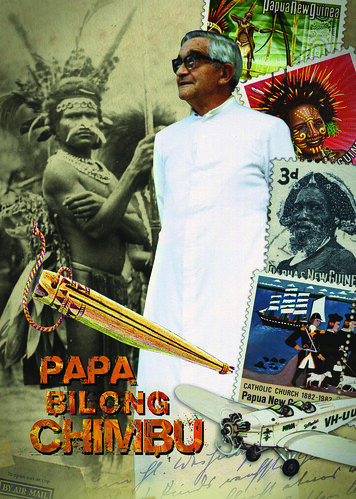
Papa Bilong Chimbu (AUSTRALIA 2007) poster

Trailervideo: http://blip.tv/file/2253184 + http://www.youtube.com/watch?v=dTClVrRB1WA

Englische Synopsis: Set against a backdrop of colonialism, war, religion and the birth of a nation, Papa Bilong Chimbu offers a personal perspective on cultural exchange and ‘big picture’ history of Papua New Guinea by tracing the story of one man and his legacy.

Englische Werkbeschreibung: In 1937 a young Catholic missionary, Father John Nilles, arrived in the highlands of Papua New Guinea – one of the first whites the local people had ever seen. There he would stay for the next 54 years, living with the people of Chimbu, learning their language and way of life, introducing them to his God and Western culture. More than just a priest, he would become an anthropologist, linguist, politician and clan leader. In Papa Bilong Chimbu, filmmaker Verena Thomas embarks on a journey of her own. Through Nilles’ extraordinary archive of diaries, letters and photos (which have never been seen before) as well as interviews with those who knew him, she pieces together a portrait of this fascinating man – her great-uncle. What she discovers is an unexpected new family, who had made ‘Papa’ Nilles one of their own. More than a decade after his sudden departure, they continue to feel a deep sense of loss and injustice. Set against a backdrop of colonialism, war, religion and the birth of a nation, Papa Bilong Chimbu offers a personal perspective on ‘big picture’ history by tracing the story of one man and his legacy. It’s a story about respect and what it means to belong. A thought-provoking insight into the complexity of cultural exchange, and the beauty, vulnerability and strength of a country and its people.

Papa Bilong Chimbu (AUSTRALIA 2007) Director Verena Thomas

Dieser Film aus dem Programm des Globians Doc Fest wird wiederholt und zwar am 04. November 2009 um 22.30 Uhr im Berliner Kino "Eva Lichtspiele", Blissestraße 18, Berlin-Wilmersdorf, U-Bahnhof Blissestraße.

GLOBIANS DOC FEST BERLIN
August 12 - 17, 2009
Kino Toni, Antonplatz

Langzeit-Traumata (2) Indonesien |
Heilung als kultureller und sozialer Prozess (4):
40 Jahre nach dem Massenmord durch das Suharto-Regime

Film-Nr.: 631
Vorführungstermin: Montag, 17. August 2009, 16 Uhr [VN63]
Themenschwerpunkt: Langzeit-Traumata (2) Indonesien | Archäologie - Anthropologie - Ethnologie (7) | Heilung als kultureller und sozialer Prozess (4)

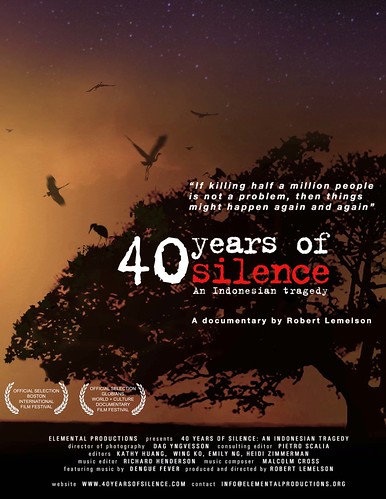
Englischer Titel: 40 Years of Silence: An Indonesian Tragedy
Originaltitel: 40 Years of Silence: An Indonesian Tragedy
Deutscher Titel: 40 Jahre Schweigen: eine indonesische Tragödie
Herkunft: USA 2008
Laufzeit: 96 min.
Sprachfassung: Indonesisch-balinesisch-englische Originalfassung mit englischen Untertiteln

Regie: Robert Lemelson
Produzent: Robert Lemelson
Kamera: Dag Yngvesson
Schnitt: Dag Yngvesson, Emily Ng, Heidi Zimmerman, Kathy Huang, Wing Ko, Richard Henderson (sound)
Musik: Malcolm Cross
Produktion: Elemental Productions, Pacific Palisades (Kalifornien)

URL Film-Homepage: http://www.elementalproductions.org
Premierenstatus: Internationale Premiere
Bisherige Aufführungen: Boston International Film Festival, Boston (Massachusetts) USA;


Kurzinhalt: Es ist einer der größten Massenmorde des 20. Jahrhunderts, kaum bekannt und noch weniger erinnert: Im Machtspiel des Kalten Kriegs lässt General Suharto in Indonesien zwischen 500.000 und 1.000.000 Menschen als angebliche "Kommunisten" ermorden und zwar in einem extrem komplexen Folge von Ereignissen, die im Herbst 1965 beginnen. Das Suharto-Regime kann dadurch seine militärische Herrschaft und letztlich auch die Machtergreifung von Suharto als Staatsoberhauptes von Indonesien durchsetzen und für Jahrzehnte festigen. Wie auch bei der Schreckensherrschaft der Roten Khmer in Kambodscha haben die südost-asiatischen Kulturen erhebliche Schwierigkeiten bei der Aufarbeitung von Leiden, Schuld und Sühne. Die Anthropologe und Psychotherapeut Robert Lemelson versucht in dieser Langzeitstudie Wege der Aufarbeitung und Heilung für die überlebenden Opfer und ihre Familien aufzuzeigen: ein bewegender und erschütternder Film.

Videos:
Teaser: http://blip.tv/file/2236913 + http://www.youtube.com/watch?v=EpppIAv-bV0&feature=channel_page
Trailer: http://blip.tv/file/2237350 + http://www.youtube.com/watch?v=bQAlqcV1QW0&feature=channel_page
Director's Statement: http://blip.tv/file/2237015

Englische Synopsis: In one of the largest unknown mass-killings of the 20th century, an estimated 500,000 to 1,000,000 people were secretly and systematically killed in 1965 when General Suharto launched a bloody purge of suspected “communists” in Indonesia through a complex and highly contested series of events through which he ultimately gained power and the presidency. During Suharto's authoritarian rule, any discussion or memorializing of the killings that differs from the official state narrative has been suppressed. '40 Years of Silence: An Indonesian Tragedy' follows the brave testimonies of four individuals and their families through a multi-generational perspective as they break the silence and reflect upon how the long-term, traumatic effects of the 1965 mass-killings has reverberated painfully in their lives till the present day

40 Years of Silence: An Indonesian Tragedy (USA 2008) Poster

Englische Werkbeschreibung: Directed by documentary filmmaker and world renowned-psychological anthropologist Robert Lemelson, “40 Years of Silence: An Indonesian Tragedy” is the moving feature length documentary film about one of the most horrific chapters in Indonesia’s history. In one of the largest unknown mass-killings of the 20th century, an estimated 500,000 to 1,000,000 people were secretly and systematically killed in 1965, when General Suharto began a bloody purge of suspected “communists” throughout Indonesia. Wielding his growing influence through a complex and highly contested series of events to install his New Order regime, Suharto ultimately gained power and the presidency of the country. Under his authoritarian rule, any discussion, recognition or memorializing of the mass killings that differed from the Suharto’s official state narrative was quickly suppressed. “40 Years of Silence: An Indonesian Tragedy” follows the compelling testimonies of four individuals and their families from Central Java and Bali, two regions heavily affected by the purge. As they break their silence publicly for the first time, each family provides an intimate and frightening look at what it was like for survivors of the mass-killings. In chilling detail, they describe the events of 1965 through their own experiences, re-living and reflecting upon the stigmatization and brutalization they continue to endure on both the village and state levels. Over time, the survivors and their families attempt to find ways to deal with a tragedy that was, and is still not, openly recognized by their neighbors, government or the world. Through their stories, the audience will come to understand modern-day Indonesia’s potential for retribution, rehabilitation and reconciliation within this troubled historical context. “40 Years of Silence: An Indonesian Tragedy” was produced by Lemelson’s Elemental Productions. Based in Los Angeles, Elemental Productions is dedicated to the production of ethnographic documentaries focusing on the relationship between culture, psychology and personal experience in Indonesia and the United States. For more information on “40 Years of Silence: An Indonesian Tragedy,” Elemental Productions and other films from the company, please visit www.elementalproductions.org.

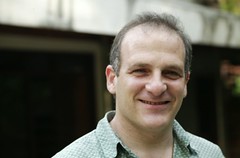
40 Years of Silence: An Indonesian Tragedy (USA 2008) Director Robert Lemelson

Dieser Film aus dem Programm des Globians Doc Fest wird wiederholt und zwar am 25.November 2009 um 18.30 Uhr im Eiffelturm-Kino Berlin (im Centre Français de Berlin), Müllerstr. 74, U-Bahnhof Rehberge/Afrikanische Straße.

GLOBIANS DOC FEST BERLIN
August 12 - 17, 2009
Kino Toni, Antonplatz