Posts mit dem Label Internationale Premiere werden angezeigt. Alle Posts anzeigen

Samstag, 13. Juni 2009

Papier als Kunst, Papier als Kriegswaffe (1): Die Papier-Kunst der Maya Onoda

Film-Nr.: 131
Vorführungstermin: Mittwoch, 12. August 2009, 21 Uhr (Vorfilm) [VN13]
Themenschwerpunkt: Japan-USA (1) | Papier als Kunst, Papier als Kriegswaffe (1)

Englischer Titel: MAYA ONODA — Nomadic Home
Originaltitel: MAYA ONODA — Nomadic Home
Deutscher Titel: MAYA ONODA — Nomadisches Zuhause
Herkunft: USA 2008
Laufzeit: 25 min
Sprachfassung: Englische Originalfassung

Regie: Rima Yamazaki
Produzent: Rima Yamazaki
Schnitt: Rima Yamazaki
Kamera: Rima Yamazaki

URL Film-Homepage: http://rimasweblog.blogspot.com/2008/10/maya-onoda-nomadic-home.html + http://rimasweblog.blogspot.com/
Premierenstatus: Internationale Premiere
Bisherige Aufführungen: NewFilmmakers Spring Festival in New York, USA (WP)

Kurzinhalt: Die Arbeit mit Papier der japanischen Künstlerin Maya Onoda, die Brooklyn, New York, als ihre "nomadische Heimat" bezeichnet.

Trailervideo: http://blip.tv/file/2242971 + http://www.youtube.com/watch?v=K7bjMRolHe8&feature=PlayList&p=4B4FE5E49176D406&index=9

Englische Synopsis: This documentary is about a young Japanese artist, Maya Onoda, living and working in Brooklyn, New York. She considers herself as a 'nomad' and her art which she makes as her 'nomadic' home. Introducing her art, this documentary seeks what she is trying to do through making art and what her identity is like here in the United States, which is far away from her own country.

MAYA ONODA — Nomadic Home (USA 2008)
photo: Maya Onoda

Englische Werkbeschreibung: New York is an artworld center. But at the same time, there are also big issues of culture, identity and nationality for foreign artists. How does it influence the artists and their art to live and work in a foreign city? This documentary is about Maya Onoda, a Japanese artist living and working in New York City. She came to the United States ten years ago and she studied art at California State University. After she earned a BFA there, she moved to New York, which was about 4 years ago. She received a MFA at Pratt Institution in Brooklyn and currently she belongs to Magnan Projects Gallery in New York. Maya makes installation art. She considers herself as a “nomad” because she goes back and forth between two different cultures, American and Japanese cultures. She also calls her installation art as a “nomadic tent,” which means a portable home she can carry around anywhere with her. Her installation creates an intimate atmosphere. She uses materials which she collects in her daily life. She gives another lives to these materials by “recycling” them, turning them into art. These performances — collecting and recycling — are deeply related to her memory of her childhood and her mother. Most Japanese women, especially older generation, have habits of collecting things and making another things from old stuffs by recycling. Sewing which she often uses in her art is also related to her mother; her mother was good at dressmaking and Maya had often seen her mother sewing and making clothes for her. However, her art has not only a “Japanese” sense. After she moved to the United States, she discovered her own identity, which was not only as a Japanese, but as “herself.” That is another reason why she considers herself as a “nomad.” She maintains her true identity through making her art, her “nomadic home” in a foreign city.

Director's Bio: Rima Yamazaki is a documentary film/videomaker born in Japan, 1982, living and working in New York since 2006. She studied Sociology at Hitotsubashi University in Japan and earned a B.A. in Sociology. There she mainly studied about Muslim immigrants in European countries, but through making documentary videos based on field researches, her interest gradually shifted to visual art. She made her first documentary video “Color on Colors” in 2004, which is about a young Japanese artist, Satoshi Uchiumi. After she moved to New York in 2006, she started focusing on making documentaries on art and artists, such as “In the Studios: 6 MFA Students at Hunter College in New York” and “MAYA ONODA: Nomadic Home.” Now she is also interested in cultural relationships and artists living in the globalized world.

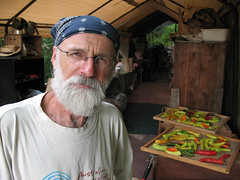
MAYA ONODA — Nomadic Home (USA 2008) director Rima Yamazaki
photo: Rima Yamazaki

GLOBIANS DOC FEST BERLIN
August 12 - 17, 2009
Kino Toni, Antonplatz

Yes we can! — Obamas Amerika (4): 40 Jahre nach Woodstock — Flower Power ist wieder da! — Zurück zum Garten der Blumenkinder

Film-Nr.: 232
Vorführungstermin: Donnerstag, 13. August 2009, 16.45 Uhr (Hauptfilm) [VN23]
Themenschwerpunkt: Yes we can! — Obamas Amerika (4)


Englischer Titel: Back to the Garden, flower power comes full circle
Originaltitel: Back to the Garden, flower power comes full circle
Deutscher Titel: Zurück zum Garten: Flower Power ist wieder da
Herkunft: USA 2009
Laufzeit: 69 min.
Sprachfassung: Englische Originalfassung

Regie: Kevin Tomlinson
Produzent: Kevin Tomlinson
Schnitt: Tim Cash
Kamera: Kevin Tomlinson
Musik: Band of Annuals, Harvey Swanson and more...
Produktion: Heaven Scent Films, Seattle

URL Film-Homepage: http://backtothegardenfilm.com/
Premierenstatus: Internationale Premiere
Bisherige Aufführungen: Maui Film Festival, Hawaii, USA; Seattle International Film Festival, Washington, USA


Kurzinhalt: Die Ende der 1960er-Jahre pionierhaften Lebensstil-Reformen der Blumenkinder erscheinen bei derzeit immer näher kommenden Einschlägen des globalen Ökonomieversagens heute weiser als je zuvor: Fragen von Nachhaltigkeit, Überschaubarkeit von Lebenszusammenhängen, Kleinraum-Bewirtschaftung, Selbstverantwortung und Verantwortung des Einzelnen für Lebensgemeinschaften drängen als politische Forderungen wieder an die Oberfläche. Die von Kevin Tomlinson in den 1980er-Jahren filmisch eingefangenen „Überbleibsel“ dieser Lebensstil-Reformen in den USA waren damals, in den 80ern, doch recht randständig und rudimentär. Wie sich die Zeiten doch ändern...

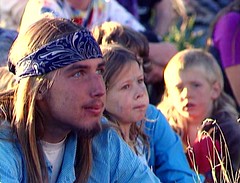
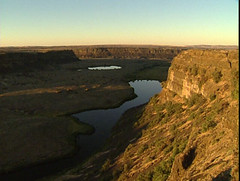
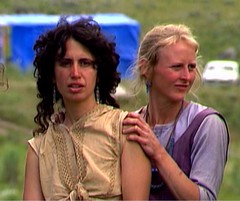
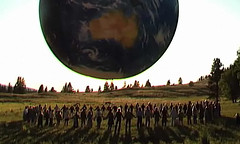
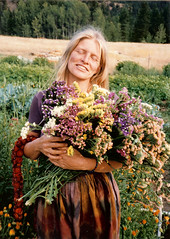
Back to the Garden, flower power comes full circle (USA 2008) stillBack to the Garden, flower power comes full circle (USA 2008) stillBack to the Garden, flower power comes full circle (USA 2008) still


Trailervideo: http://globians.blip.tv/file/2269227/ + http://www.youtube.com/watch?v=n3qq-hJs5FM

Englische Synopsis: Where have all the flowers gone? In 1988—twenty years after Woodstock—Seattle filmmaker Kevin Tomlinson asked himself that question. What he discovered back then, through in-depth interviews at a 4 day 'healing gathering' which drew 500 back to the land hippies, was that small counterculture communities of sixties dropouts were intact and surviving in the back country. In fact, they were thriving in the eighties, living off the rich, rural land of Washington state and refining sixties “hippie” concepts—completely independent of a culture that had all but forgotten and marginalized them. His footage sat untouched for 20 years. In 2008, in the tradition of 'Seven Up,' Tomlinson revived these old tapes and was deeply moved. What these outsiders were talking about in the eighties: sustainability, simplicity, family, love for the earth, self-reliance, and community responsibility—seemed to be blossoming with incredible force, 20 years later, into the mainstream. He decided to seek out his subjects again. The intimate and personal journey that followed offers profound, moving insights into one of the most iconic social movements of our time—and speaks to all of us. The pioneering lifestyles of these aging hippies and their now-thriving families, firmly insulated from global economic shocks, today looks wiser than ever.

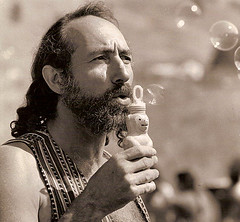
Back to the Garden (USA 2009) 40 years after Woodstock: flower power comes full circle>Back to the Garden (USA 2009) 40 years after Woodstock: flower power comes full circle>Back to the Garden (USA 2009) 40 years after Woodstock: flower power comes full circle

Englische Werkbeschreibung: In the 60's, they were satirized and vilified for rejecting materialism and corporate culture, in the 70's, they stopped the war, started communes, urged back to the land and environmental sustainability, but by the 80's they had virtually disappeared from everyday life…. Then, the millenium turned, the economy fell apart and our presidential candidates began making global sustainability and climate change their life's work. When nothing in our 'standard operating proceedure' is working, it's those counterculture adherents that have something to tell us. So where have all the flower children gone? In 1988—nearly twenty years after Woodstock-Seattle filmmaker Kevin Tomlinson asked himself that question while interviewing a large group of back to the land hippies at a backcountry healing gathering in Washington State. He found that small embers of the greater counterculture communities of sixties dropouts were still intact and thriving contrary to popular belief and were raising families and refining their hippie idealism—independent of a mass culture that had marginalized and all but forgotten them. Doubtful about how seriously this would be received in ’88, His footage sat untouched for almost 20 years. In 2006, Tomlinson took another look. What these off-grid, Hippies were talking about in ‘88—sustainability, living a simpler life, love for the earth, questioning authority, self-reliance, and community responsibility—seemed to be blossoming with incredible force and coming full circle 20 years later as the impact of climate change, an unpopular war, shopping as patriotism and the green movement have come into the mainstream discussion. He set out to find his original subjects again. Had their radical ideals survived, had anyone gone mainstream? What about their children…how did they rebel against the rebel generation? The adventure that followed offers profound, moving insights into one of the most iconic social movements of our time—and speaks to all of us who grew up then or were affected by the sixties counterculture. The non-conformist lifestyles of these aging back to the landers and their now-thriving families, firmly insulated from global economic shocks, today looks ahead of its time and wiser than ever. But the film also seeks to find out…what price the dream?

Back to the Garden, flower power comes full circle (USA 2008) stillBack to the Garden, flower power comes full circle (USA 2008) stillBack to the Garden, flower power comes full circle (USA 2008) still

Director's Bio: Kevin Tomlinson has been an independent Seattle-based producer, director and cinematographer for over 25 years. He has earned numerous Emmys & Tellys for his network news camerawork with NBC (Winter Olympics, Dateline, Today show, Nightly News) ABC (20/20) CBS, (48 hours, 60 minutes) PBS (McNeil/Lehrer, Bill Nye the Science Guy) as well as Discovery, Nickelodeon, Japanese TV (NHK, TV Ashahi) German TV (ZDF, Pro Sieben), Italy (RAI), and more. As a cinematographer, Tomlinson has shot documentaries and travel programs throughout Europe, Turkey, Morocco, Haiti, Peru, Sri Lanka, Siberia and India. Many shows have been broadcast nationally on the PBS series Rick Steves’ Europe, winning a golden Cine Eagle award (2001). He currently shoots documentary and corporate programs for Microsoft, The Bill and Melinda Gates Foundation and non-profit organizations Bridges to Understanding and Interplast. Kevin has taught filmmaking at the Seattle Film Institute and 911 Media Arts teaching Digital Video and Documentary Production since 2004.

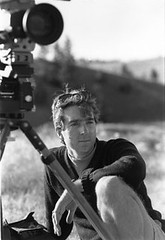
Back to the Garden (USA 2009 Director Kevin Tomlinson>Back to the Garden, flower power comes full circle (USA 2008) Director Kevin Tomlinson

GLOBIANS DOC FEST BERLIN
August 12 - 17, 2009
Kino Toni, Antonplatz
Yes we can! — Obamas Amerika (7): Vom Wunderkind-Physiker zum Ökoterroristen — die Geschichte des Billy Cottrell

Film-Nr.: 261
Vorführungstermin: Donnerstag, 13. August 2009, 22.15 Uhr [VN26]
Themenschwerpunkt: Yes we can! — Obamas Amerika (7)

Englischer Titel: Standard Deviation
Originaltitel: Standard Deviation
Deutscher Titel: Norm-Abweichung
Herkunft: USA 2008
Laufzeit: 40 min
Sprachfassung: Englische Originalfassung

Regie: Christopher Brannan, David Randag
Produzent: Christopher Brannan, David Randag
Schnitt: David Randag
Kamera: Christopher Brannan, David Randag, Joshua Woltermann, Steven Puglia
Musik: Thad Anderson
Produktion:

URL Film-Homepage:
Premierenstatus: Internationale Premiere
Bisherige Aufführungen: Buffalo Niagara Film Festival, Buffalo (New York) USA; Student Emmy Awards Gala/Screening, Student Emmy in Documentary Film, Culver City (Kalifornien) USA; Fort Lauderdale International Film Festival, Fort Lauderdale (Forida) USA (First Place, Student Films); San Francisco Documentary Festival, San Francisco (Kalifornien) USA; Daytona Beach Film Festival, Daytona Beach, USA (Audience Award); Academy of Television Arts and Sciences, North Hollywood (Kalifornien) USA; Jacksonville Film Festival, Jacksonville (Florida), USA.


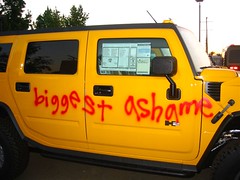
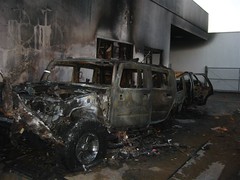
Kurzinhalt: Die Lebensgeschichte des Billy Cottrell, der als hochbegabter und talentierter Nachwuchsforscher der Astrophysik durch die Verübung von Brandanschlägen auf Autohäuser (mit Totalschäden an über 130 Geländewagen) zu einem Öko-Terroristen wurde und nach seiner Verhaftung nun im Gefängnis sitzt.

Trailervideos:
Trailer: http://blip.tv/file/2237266 + http://www.youtube.com/watch?v=CROtB7FDJ0w&feature=channel_page
Directors' Statement: http://blip.tv/file/2237288

Englische Synopsis: Standard Deviation is a documentary film about Billy Cottrell, the brilliant young physicist turned ecoterrorist.

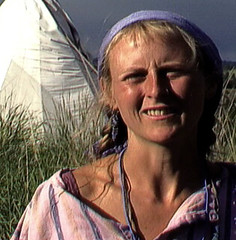
Standard Deviation (USA 2008)Standard Deviation (USA 2008)

Englische Werkbeschreibung: Standard Deviation is the story of Billy Cottrell, the brilliant young physicist turned eco-terrorist. From an early age it was clear that Billy Cottrell was different from the other children. His passion for math and physics was only intensified by his inability to connect with other children. Despite the struggles of his childhood and adolescence, at age 23 Billy was living his dream as a physicist. Billy had won a coveted spot as a PhD candidate in string theory at the prestigious California Institute of Technology. To the shock of everyone the FBI arrested Billy in March 2004. Billy had been caught sending e-mails to the Los Angeles Times claiming responsibility for a series of arsons and the vandalism for over 130 SUVs. In order to understand how Billy could become involved in such activity his loved ones look for clues in his past to understand the young genius who is looking to spend the rest of his life in prison. Standard Deviation is the pursuit of the truth and motivations of Billy Cottrell from his childhood to the events leading to his incarceration.

GLOBIANS DOC FEST BERLIN
August 12 - 17, 2009
Kino Toni, Antonplatz
Freitag, 12. Juni 2009

…übrigens: FROHE OSTERN!
Australischer Kulturraum (2) | Deutsche im Ausland (1)

Film-Nr.: 612
Vorführungstermin: Montag, 17. August 2009, 13 Uhr (Zweiter Film) [VN61]
Themenschwerpunkt: Australischer Kulturraum (2) | Deutsche im Ausland (1)

Englischer Titel: Frohe Ostern! (Happy Easter!)
Originaltitel: Frohe Ostern! (Happy Easter!)
Deutscher Titel: Happy Easter! (Frohe Ostern!)
Herkunft: Australien 2009
Laufzeit: 26 min.
Sprachfassung: Deutsch-Englische Sprachfassung mit englischen Untertiteln

Regie: Anna Jeffries
Produzent: Lacey Teh
Schnitt: Andrew Stalph
Kamera: James Teh
Musik:
Produktion: Peace Charger Productions, St. Kilda (Victoria)

Premierenstatus: Internationale Premiere
Bisherige Aufführungen: FilmFest@Falls, Falls Creek, Australien (WP)

Kurzinhalt: Alljährlich trifft sich eine Gruppe von 50 Familien und Freunden zu einem Oster-Camp am Ufer des australischen Murray River, bei der deutsches Oster-Brauchtum über drei Generationen hinweg als mehrtätiges Fest gefeiert wird.

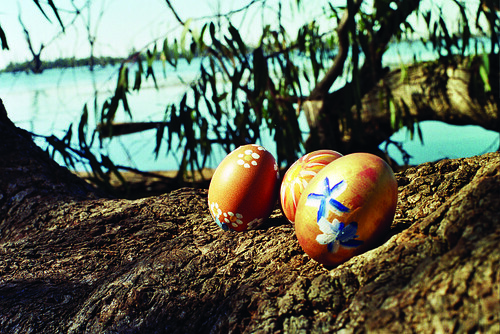
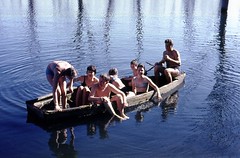
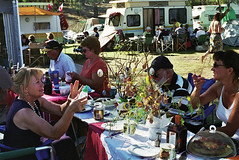
Frohe Ostern! Happy Easter! (Australia 2008)

Trailervideo: http://blip.tv./file/2386110 + http://www.youtube.com/watch?v=xeMvzBMbDT8

Englische Synopsis: The collaged history of a joyful Easter camping ritual celebrates German migrants becoming three generations of Australians.

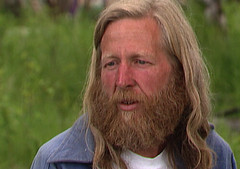
Frohe Ostern! Happy Easter! (Australia 2008)>Frohe Ostern! Happy Easter! (Australia 2008)

Englische Werkbeschreibung: A large group of more than fifty family and friends have camped in the same spot on Australia’s Murray River every Easter for the last 40 years. Within the very Australian Easter tradition of camping holidays, their own German and unique rituals have evolved. They effortlessly carry out a fixed routine of activities: nest-making for the Easter Bunny’s Eggs, an enormous Erbsensuppe (Pea Soup), silly Sunday competitions, a decadent formal afternoon tea and a magical lantern walk on Sunday night. Started by fourteen young German migrants in 1969, three generations have keenly kept these habits up and amidst a social climate of dying traditions; the youngest seem likely to maintain them. Time is gently explored and danced with through a goldmine of material that conveys traditions and people growing and a landscape changing over 4 decades. Frohe Ostern! (Happy Easter!) is a high spirited micro-history that celebrates migrants becoming Australians over 40 years and their growing families embracing the German heritage.

Frohe Ostern! Happy Easter! (Australia 2008) Director Anna Jeffries

GLOBIANS DOC FEST BERLIN
August 12 - 17, 2009
Kino Toni, Antonplatz
Langzeit-Traumata (2) Indonesien |
Heilung als kultureller und sozialer Prozess (4):
40 Jahre nach dem Massenmord durch das Suharto-Regime

Film-Nr.: 631
Vorführungstermin: Montag, 17. August 2009, 16 Uhr [VN63]
Themenschwerpunkt: Langzeit-Traumata (2) Indonesien | Archäologie - Anthropologie - Ethnologie (7) | Heilung als kultureller und sozialer Prozess (4)

Englischer Titel: 40 Years of Silence: An Indonesian Tragedy
Originaltitel: 40 Years of Silence: An Indonesian Tragedy
Deutscher Titel: 40 Jahre Schweigen: eine indonesische Tragödie
Herkunft: USA 2008
Laufzeit: 96 min.
Sprachfassung: Indonesisch-balinesisch-englische Originalfassung mit englischen Untertiteln

Regie: Robert Lemelson
Produzent: Robert Lemelson
Kamera: Dag Yngvesson
Schnitt: Dag Yngvesson, Emily Ng, Heidi Zimmerman, Kathy Huang, Wing Ko, Richard Henderson (sound)
Musik: Malcolm Cross
Produktion: Elemental Productions, Pacific Palisades (Kalifornien)

URL Film-Homepage: http://www.elementalproductions.org
Premierenstatus: Internationale Premiere
Bisherige Aufführungen: Boston International Film Festival, Boston (Massachusetts) USA;


Kurzinhalt: Es ist einer der größten Massenmorde des 20. Jahrhunderts, kaum bekannt und noch weniger erinnert: Im Machtspiel des Kalten Kriegs lässt General Suharto in Indonesien zwischen 500.000 und 1.000.000 Menschen als angebliche "Kommunisten" ermorden und zwar in einem extrem komplexen Folge von Ereignissen, die im Herbst 1965 beginnen. Das Suharto-Regime kann dadurch seine militärische Herrschaft und letztlich auch die Machtergreifung von Suharto als Staatsoberhauptes von Indonesien durchsetzen und für Jahrzehnte festigen. Wie auch bei der Schreckensherrschaft der Roten Khmer in Kambodscha haben die südost-asiatischen Kulturen erhebliche Schwierigkeiten bei der Aufarbeitung von Leiden, Schuld und Sühne. Die Anthropologe und Psychotherapeut Robert Lemelson versucht in dieser Langzeitstudie Wege der Aufarbeitung und Heilung für die überlebenden Opfer und ihre Familien aufzuzeigen: ein bewegender und erschütternder Film.

Videos:
Teaser: http://blip.tv/file/2236913 + http://www.youtube.com/watch?v=EpppIAv-bV0&feature=channel_page
Trailer: http://blip.tv/file/2237350 + http://www.youtube.com/watch?v=bQAlqcV1QW0&feature=channel_page
Director's Statement: http://blip.tv/file/2237015

Englische Synopsis: In one of the largest unknown mass-killings of the 20th century, an estimated 500,000 to 1,000,000 people were secretly and systematically killed in 1965 when General Suharto launched a bloody purge of suspected “communists” in Indonesia through a complex and highly contested series of events through which he ultimately gained power and the presidency. During Suharto's authoritarian rule, any discussion or memorializing of the killings that differs from the official state narrative has been suppressed. '40 Years of Silence: An Indonesian Tragedy' follows the brave testimonies of four individuals and their families through a multi-generational perspective as they break the silence and reflect upon how the long-term, traumatic effects of the 1965 mass-killings has reverberated painfully in their lives till the present day

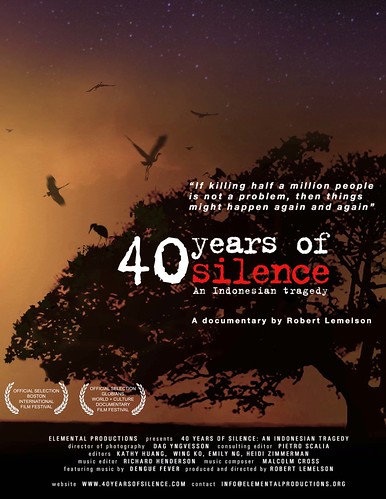
40 Years of Silence: An Indonesian Tragedy (USA 2008) Poster

Englische Werkbeschreibung: Directed by documentary filmmaker and world renowned-psychological anthropologist Robert Lemelson, “40 Years of Silence: An Indonesian Tragedy” is the moving feature length documentary film about one of the most horrific chapters in Indonesia’s history. In one of the largest unknown mass-killings of the 20th century, an estimated 500,000 to 1,000,000 people were secretly and systematically killed in 1965, when General Suharto began a bloody purge of suspected “communists” throughout Indonesia. Wielding his growing influence through a complex and highly contested series of events to install his New Order regime, Suharto ultimately gained power and the presidency of the country. Under his authoritarian rule, any discussion, recognition or memorializing of the mass killings that differed from the Suharto’s official state narrative was quickly suppressed. “40 Years of Silence: An Indonesian Tragedy” follows the compelling testimonies of four individuals and their families from Central Java and Bali, two regions heavily affected by the purge. As they break their silence publicly for the first time, each family provides an intimate and frightening look at what it was like for survivors of the mass-killings. In chilling detail, they describe the events of 1965 through their own experiences, re-living and reflecting upon the stigmatization and brutalization they continue to endure on both the village and state levels. Over time, the survivors and their families attempt to find ways to deal with a tragedy that was, and is still not, openly recognized by their neighbors, government or the world. Through their stories, the audience will come to understand modern-day Indonesia’s potential for retribution, rehabilitation and reconciliation within this troubled historical context. “40 Years of Silence: An Indonesian Tragedy” was produced by Lemelson’s Elemental Productions. Based in Los Angeles, Elemental Productions is dedicated to the production of ethnographic documentaries focusing on the relationship between culture, psychology and personal experience in Indonesia and the United States. For more information on “40 Years of Silence: An Indonesian Tragedy,” Elemental Productions and other films from the company, please visit www.elementalproductions.org.

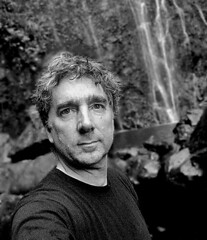
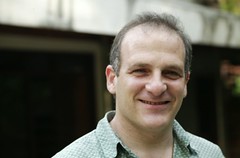
40 Years of Silence: An Indonesian Tragedy (USA 2008) Director Robert Lemelson

Dieser Film aus dem Programm des Globians Doc Fest wird wiederholt und zwar am 25.November 2009 um 18.30 Uhr im Eiffelturm-Kino Berlin (im Centre Français de Berlin), Müllerstr. 74, U-Bahnhof Rehberge/Afrikanische Straße.

GLOBIANS DOC FEST BERLIN
August 12 - 17, 2009
Kino Toni, Antonplatz